

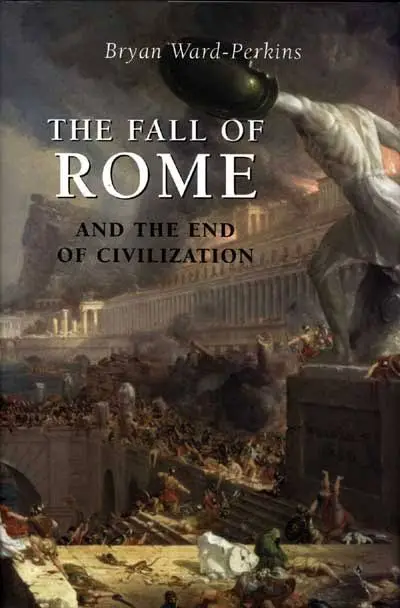
Bryan Ward-Perkins, The Fall of Rome and the End of Civilization
I bought this book years ago.
I’ve spent the last year rereading every book in my personal library about the fall of the Roman Empire and the Early Middle Ages while expanding my collection of books about this topic.
Why did the Western Roman Empire fall in the fifth century? Did the Western Roman Empire really “fall” at all in 476 or did it continue to exist under the rule of the eastern emperor in Constantinople? How did political, cultural and material life change in the barbarian successor states in the Early Middle Ages? Did the rise of Christianity cause the fall of the Western Roman Empire? Did the Western Roman Empire plunge into the Dark Ages or was there a seamless transition to Late Antiquity?
Bryan Ward-Perkins makes a compelling case that Roman civilization in the West experienced a severe collapse based on the archaeological evidence. He argues that the timing and severity of the collapse varied from region to region. At the most extreme end, the Anglo-Saxon invaders wiped out everything in Britain. Roman cities were abandoned. Roman roads deteriorated. Roman villas were sacked. Britain was plunged into a Dark Age and fell back to a pre-Roman level of technology and economic development with Christianity and literacy being later reintroduced from Ireland and the European continent.
At the opposite extreme, Egypt and the Levant continued to flourish into the seventh century and the good times kept on rolling after the Arab conquest. The Eastern Empire reached its zenith in the sixth century under Justinian. Later, Greece and the Aegean region went through its own similar material collapse as a result of the Slav and Avar invasions of the Balkans at the end of the sixth century. Byzantium survived for centuries as a truncated successor state after the loss of its richest provinces to the Umayyad Caliphate. Roman technology, building techniques and knowledge survived in the eastern Mediterranean. It makes much more sense to see this region through the lens of Late Antiquity.
In the West, the collapse happened at different times and for different reasons. Britain was the first casualty and fell out of the Roman system early in the fifth century after the usurper Constantine III took the Roman army of Britain with him to the continent. Roman Africa flourished under Vandal and Byzantine rule until the Arab conquest at the end of the seventh century when Carthage was destroyed. Gaul, Italy and Spain each had their own fate. Italy, which was always the heart of the Western Empire, was devastated and depopulated by the Gothic War and the Plague before it was overrun by the Lombards. The Visigoths in Spain and the Franks and Burgundians in Gaul ruled as a militarized elite. The Visigothic Kingdom fell to the Arabs in the eighth century. Iberia had its own Islamic trajectory afterwards. Francia became the cultural center of gravity of the post-Roman West in the Early Middle Ages.
Across the West, literacy retreated and economic complexity vanished. Standardized weapons and commercial goods disappeared. Life became much more rural and local than it had been in previous centuries when the Roman Empire maintained a single currency and infrastructure that stretched from Britain to Mesopotamia. There was a drastic decline in the material standard of living that accompanied economic simplification. Bryan Ward-Perkins talks about how post-Roman Italians became more invisible in the archaeological record because they ceased to build their homes in stone and build with tiled roofs as they had done since pre-Roman times. Italy didn’t recover from this until the Renaissance.
I thought the most insightful part of the book was when Bryan-Ward Perkins compared the collapse of Roman Britain to the Greek Dark Ages. In both cases, the root cause was an invasion by hostile outsiders and political instability which destroyed the economy. The fate of Roman Italy and Africa tell a similar story. A time traveler arriving in the Rome of 500 AD or the Carthage of 600 AD wouldn’t have reported the fall of the Roman Empire and the end of civilization, but a visitor to the London of 500 AD, the Rome of 600 AD, the Carthage of 700 AD or the Constantinople of 1400 AD would have done so. Roman Cologne in the Rhineland carried on through the Early Middle Ages until it was destroyed by the Vikings.
Roman civilization was like a field of flickering candles at night being blown out by a cold wind from north and west to south and east over the course of a thousand years.
Leave a Reply